

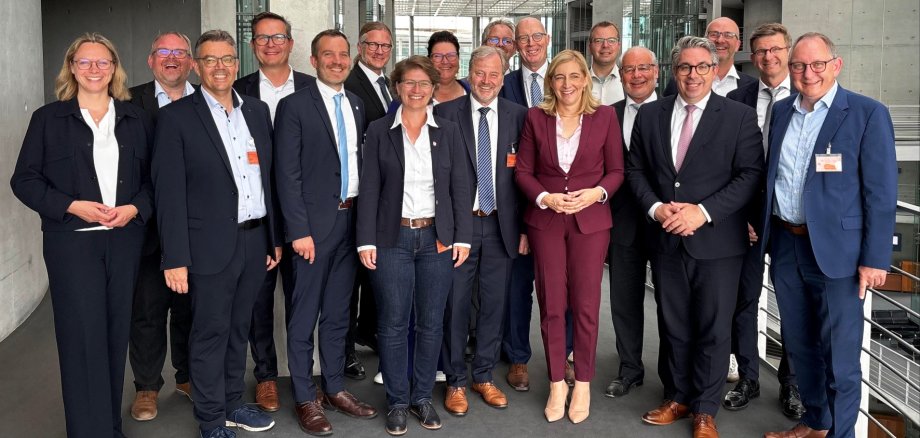
The goal of the conference in the federal capital was to draw particular attention to the difficult financial situation facing cities, municipalities, and the district. Stefan Rouenhoff (Member of the Bundestag), Parliamentary State Secretary at the Ministry of Economic Affairs, had arranged for the group to meet with high-ranking officials with whom the chief administrative officers could discuss the ever-growing municipal problems.
Together with Minister of State Dr. Michael Meister—who, among other responsibilities at the Federal Chancellery, oversees cooperation between the federal and state governments—representatives from the Kleve district discussed the inadequate financial situation of cities and municipalities. During the discussion, they raised the issue of “connexity,” for example. True to the motto “Whoever orders it, pays for it,” District Administrator Christoph Gerwers cited as an example the legal entitlement to full-day care in elementary schools (OGS) starting in 2026. The federal government initiated this, but the municipalities bear the burden. Other federal responsibilities, such as civil emergency planning and civil protection, also generate work and costs at the local level. Minister of State Dr. Meister explained that no “connexity” currently exists between the federal government and the municipalities, but that there are considerations to introduce a so-called “initiation-based connexity” in the future when changes are made to benefit laws or new laws are enacted.
The subsequent tour of the Bundestag was particularly interesting for the chief administrative officers who were elected for the first time in the last local election. During a discussion with Federal Minister of Health Nina Warken and Parliamentary State Secretary Dr. Georg Kippels, the delegation from the Kleve district addressed, among other things, the availability of family doctors in rural areas and hospital reform. Other topics included the reform of statutory health insurance (GKV) and long-term care reform, along with their financial implications for municipalities. Healthcare costs total 500 billion euros annually, which amounts to 1.4 billion euros per day. The Statutory Health Insurance Contribution Stabilization Act and the long-term care reform threaten to impose an additional burden of 6 billion euros on municipalities.
During a meeting with Dr. André Berghegger, the chief executive of the German Association of Cities and Municipalities, the financial situation of Germany’s approximately 11,000 municipalities was also discussed. The budget deficit of cities and municipalities currently totals 30 billion euros—with an investment backlog of around 230 billion euros. This is a dramatic development. Above all, social costs in the areas of integration assistance and long-term care are placing the heaviest burden on municipal budgets. Dr. Berghegger expressed the view that, in principle, sufficient funds are available. However, he noted that expenditures must be aligned with revenues, and that prioritizing tasks is necessary.
At the conclusion of their conference, the mayors and the district administrator had the opportunity to exchange views with Parliamentary State Secretary Ulrich Lange of the Federal Ministry of Transportation. The discussion focused in particular on rail transport issues, such as the completion of the “Betuwe Line,” the ongoing problems with the “Niersexpress” (RE10), and plans for an underpass on Kalkarer Straße in Goch to accommodate a bypass. They also discussed the A40, B67n, and B220n highway projects. The participants agreed that the planning processes are taking too long overall and that it is finally time to “take action.” For example, planning for the construction of the B67n has been underway since 1969. Funding for rail and federal highways must also flow to the districts—including the Kleve district—so that local communities in the region are not left behind.
“We received a lot of important information and were able to make our positions clear. This gives us hope that progress will be made in one area or another in the future. The problems facing local governments have clearly been acknowledged at the federal level. This was demonstrated, for example, by the conference between the heads of state and government of the federal states and the federal government at the end of June 2026. However, it remains to be seen whether local governments will be provided with sufficient financial resources to carry out their duties, particularly those tasks delegated to them,” said Mayor Rainer Weber, chairman of the Conference of Chief Administrative Officers.
Source: Conference of Chief Administrative Officers of the Kleve District