
Municipal heat planning
Municipal heat planning creates a coordinated basis for a greenhouse gas-neutral municipal heat supply by 2045. Until then, the municipal heat planning will be regularly updated in order to stay up to date both in terms of planning and technology.
The municipal heat planning for the pilgrimage town of Kevelaer was completed in December 2024. The results can be viewed in the final report . This overview map shows the possible heat supply areas.
Contents of municipal heat planning
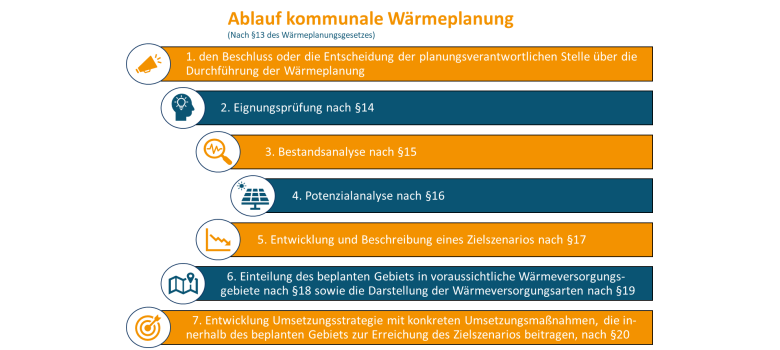
According to the Heat Planning Act, municipal heat planning comprises seven sub-steps. Following a decision by the body responsible for planning, a rough suitability test is first carried out in order to exclude sub-areas for a specific type of heat supply. The current heating infrastructure is then recorded in the inventory analysis. In the potential analysis, all renewable potential for heat generation is analyzed. Based on the results, a target scenario for a greenhouse gas-neutral heat supply is then outlined, which, among other things, makes a building-specific division into suitable areas for grid-based heat supply, supply with green gases and individual supply. The implementation strategy describes measures with which the target scenario is to be achieved. A controlling concept and a continuation strategy are also designed to ensure compliance with the targets set out in the municipal heating plan.
Aim of municipal heat planning
The goal of the pilgrimage town of Kevelaer is to use municipal heat planning to help residents choose their future heating system. Municipal heat planning is intended to help shed light on the issue, weigh the various options for heat supply, and provide guidance and a basis for planning in the coming years. To this end, in addition to relevant stakeholders such as the municipal utilities and regional energy providers, the public is also involved and regularly informed about the progress and implementation of the municipal heat planning initiative.
Furthermore, municipal heat planning involves a preliminary assessment of the feasibility of a heat network within the municipal area (see overview map of the heat network study area). In a district heating network, connected households are supplied directly with heat generated regionally from renewable energy sources—such as geothermal energy, river water heat, or biogas.
Legal Background and Classification
Municipal heat planning is mandated by the Act on Heat Planning and the Decarbonization of Heating Networks (WPG), which took effect on January 1, 2024. Municipalities such as the pilgrimage town of Kevelaer, with fewer than 100,000 residents, must develop a heating plan by June 30, 2028, in accordance with Section 4 of the WPG. The original requirement that, starting July 1, 2028, newly installed heating systems in Kevelaer must be powered by at least 65 percent renewable energy was repealed by new provisions in the Building Modernization Act (GModG) of July 29, 2026. As a result, the installation of new gas and oil heating systems is once again permitted in principle.
However, this is not necessarily the best financial decision for two reasons. First, starting in 2029, these heating systems will be subject to a gradually increasing mandatory quota for the use of climate-neutral fuels—the so-called “bio-step” (Section 43 GModG): by 2040, the share of climate-friendly fuels (e.g., green gases or bio-heating oil) must be at least 60%. Second, theCO2 price for fossil fuels will continue to rise. As of January 1, 2024, theCO2 price has risen to 45 euros per metric ton, which represents an additional cost of 0.816 cents per kilowatt-hour (kWh) of natural gas. In 2025, theCO2 price stood at 55 € per metric ton. In 2026, it will range between 55 and 65 €, depending on supply and demand. By 2045, theCO2 price will continue to rise significantly, so that, according to forecasts, theCO2 price could exceed the pure natural gas trading price in the future. Running costs should therefore be compared with caution.
Households can also use freeCO2 price calculators—such as those provided by PIK, rwi, or the Consumer Advice Center—to determine the resulting additional costs.
In many cases, the costs of measures to provide renewable heat can be significantly reduced through grants. ALTBAUNEU’s grant guide provides a good overview of this. In addition, the Kleve District offers all residents free energy counseling in cooperation with the Consumer Advice Center.